I Nyoman GUNARSA (1944–2017) – Legong Hijau (Green Legong Dancers)
Oil on canvas, signed lower left
Indonesia, circa 1965–1975
Canvas: 19 11/16 x 19 11/16 in. (50 x 50 cm)
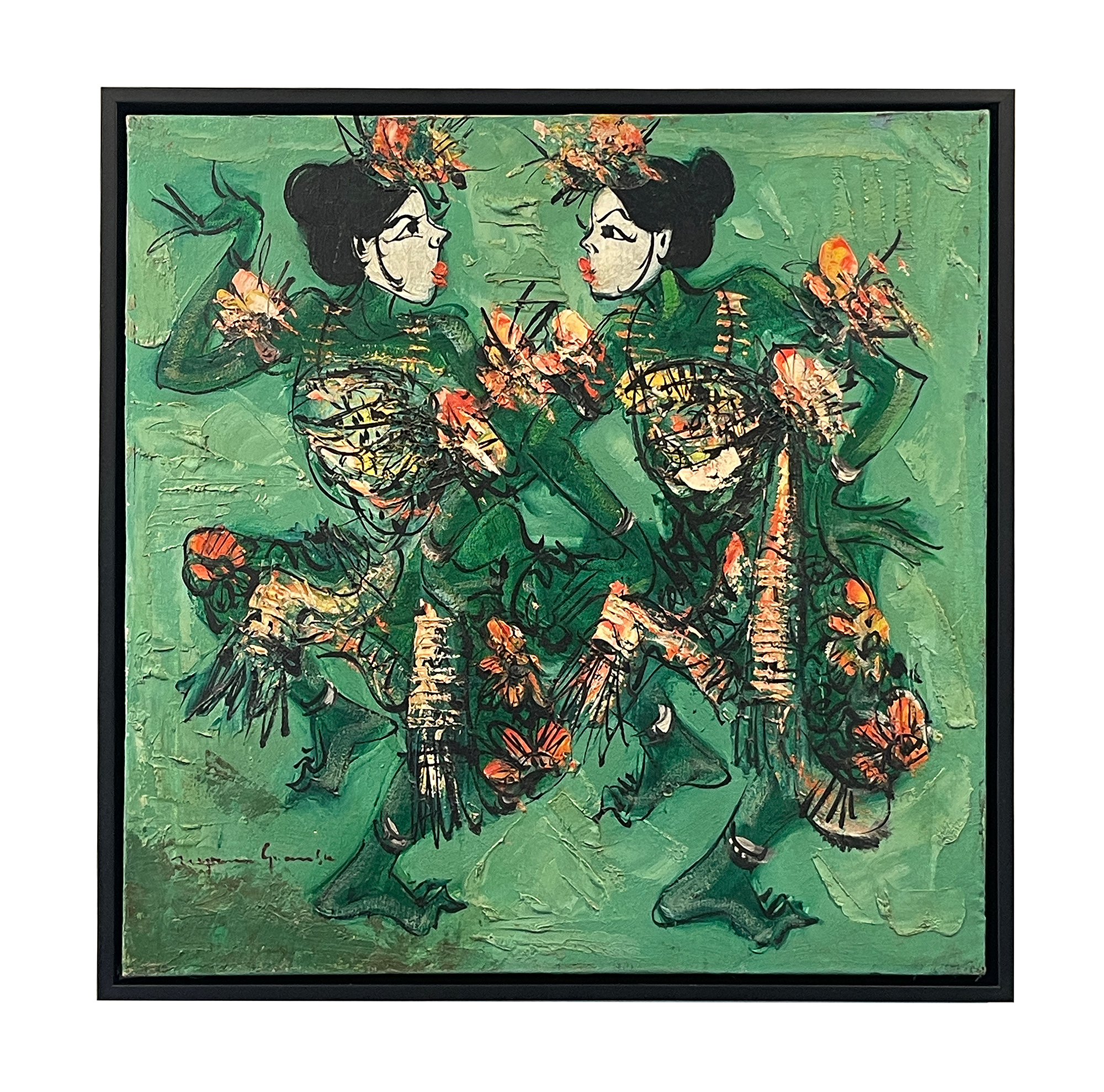
This vibrant oil painting by I Nyoman Gunarsa is a striking early representation of one of the artist’s most celebrated subjects: the graceful Legong dancers of Bali. Executed in a luminous palette dominated by emerald and jade green—hence the title Legong Hijau (“Green Legong”)—the composition depicts two dancers in elaborate ceremonial costumes, their elegant gestures and expressive faces conveying the refined choreography of the traditional Balinese court dance.
The work perfectly illustrates Gunarsa’s highly personal visual language, where energetic black calligraphic lines animate the composition with a remarkable sense of rhythm and movement. Thick impasto brushstrokes and richly textured passages bring vitality to the dancers’ floral headdresses and ornate costumes, while vivid accents of orange, coral, yellow, and white create a brilliant chromatic contrast against the green background. The expressive brushwork dissolves the boundary between figure and motion, transforming the dance into a vibrant celebration of Balinese culture.
Dedicated throughout his career to preserving and celebrating the traditions of Bali, Gunarsa developed an unmistakable style that fused modern expressionism with the island’s artistic heritage. His paintings of dancers are among his most iconic works, embodying what he described as the harmony between “singing through line and dancing through color.”
The signature found on this painting corresponds to the form used by the artist during the 1960s and 1970s, making it reasonable to date the work to this important early period, before the increasingly abstract direction his painting took during the 1980s.
Today, I Nyoman Gunarsa is recognized as one of Indonesia’s most important modern painters. His works are represented in major public and private collections and remain highly sought after for their expressive energy, cultural authenticity, and unmistakable celebration of Balinese life.